Resources: How to Choose a Women-Only Gym or Pilates Studio
This guide helps a reader in Massachusetts choose a women-only gym or a Pilates studio, starting from what they will actually do each week. It compares four formats on the points that matter most to a reader. It shows what the contract has to say before anyone signs. It gives the questions to put to any place on a visit or a call. Every figure in it is counted from our own material or sourced beside it.
Using this guide, in order
Pick the week first
Write down how many sessions a week you can realistically make, and what you want to do in them. Lifting, Pilates, set classes and fitting around childcare or shifts each point to a different format. If you are coming back after a break, plan for a shorter first month. Be honest about the week, because a plan that needs more time than you have will fail. The place comes last, once the format is clear.
Match the format to the week
Read across the table further down and find the row that fits the week you wrote down. Each row says who the format suits and what it costs you in time, money and flexibility. Check the weak point in that row before you look at any single place. A format that fits your week is worth more than a familiar name. Two formats may fit equally well, and that is a fine result.
Test the place with questions
Take the visit questions further down this page to the place you are considering. Ask each one, and listen for the good or poor answer described beside it. A clear, written answer is worth more than a verbal promise. If a place cannot answer a question, note that and ask again on the next visit. Then decide, using the contract rules as your floor.
What a coached session can look like
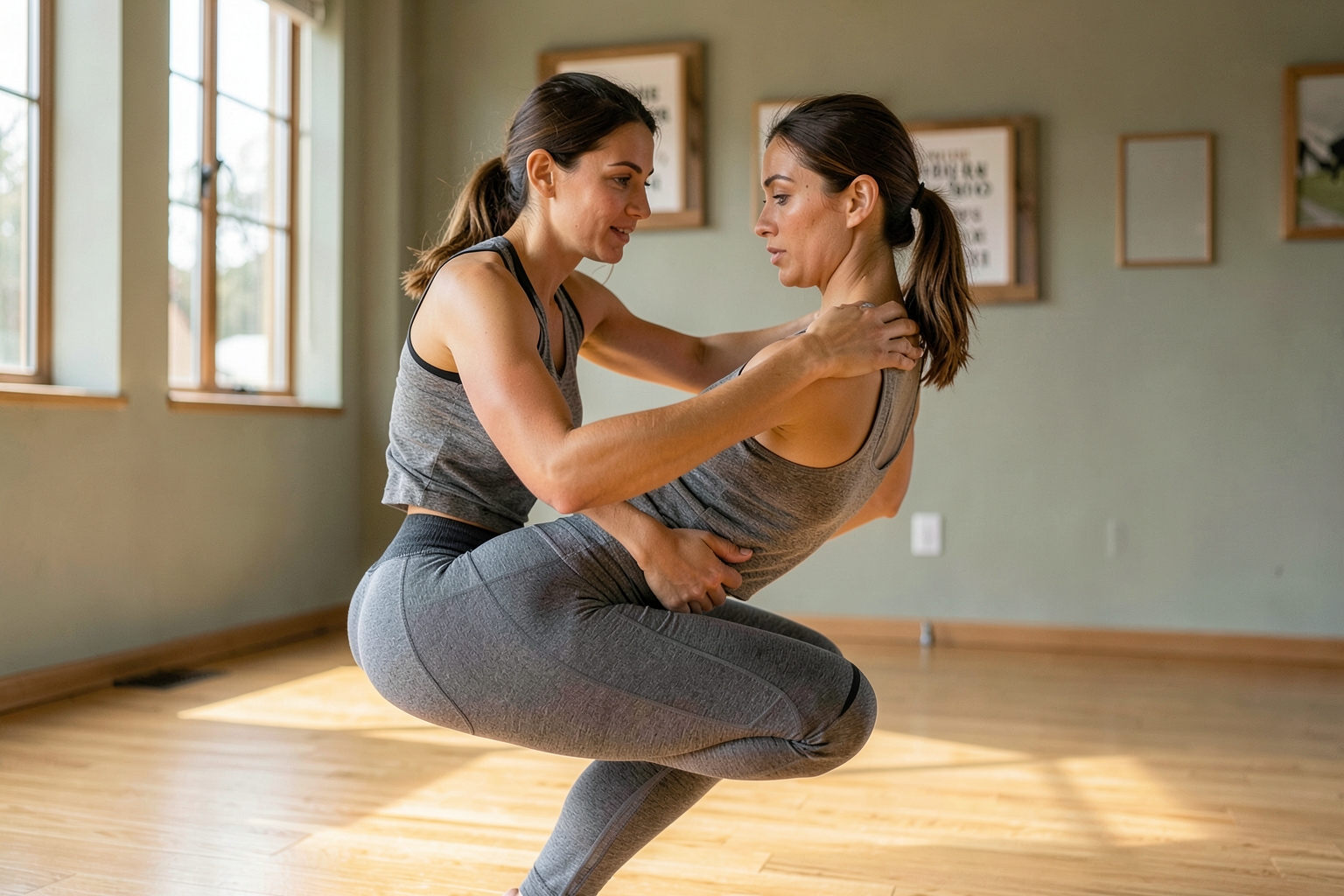

Four formats, side by side
These are general trade-offs, not a ranking. Prices, class sizes and hours differ from place to place and season to season. So the table names what each format costs you in time, money and flexibility, rather than quoting a figure. Read across a row to see who the format suits and where it falls short. Then check each claim on a visit, because a single place can differ from the general pattern.
| Format | Suits | What it costs you | Where it is weak |
|---|---|---|---|
| Women-only gym floor | Lifting and machines at your own pace | Dues, often on a contract; travel and opening hours | Little guidance unless coaching is included |
| Pilates studio, mat and reformer | Body-weight control, mobility or a gentle start | Class or pack fees; reformer usually costs more per class | Mat gives less resistance; reformer depends on booked slots |
| Small-group studio | A set class with a coach watching your form | Fixed schedule and class packs; less freedom to drop in | Fewer machines and less free practice time |
| Mixed big gym with women’s hours | One place for everything, on set hours | A broad membership fee for a large floor | Women’s hours may be shorter or busier |
In Massachusetts, a women-only policy is allowed only at a bona fide fitness facility that exists solely to promote health through exercise and instruction and takes no government funds. The rule comes from General Laws, Chapter 272, Section 92A. So a women-only policy is lawful where that test is met, and it is fair to ask how a given place meets it. A reader who wants to be sure can ask the place which of those conditions it meets. Asking is a normal part of a visit, and a clear answer is a good sign.
Read the contract before you pay
Massachusetts sets limits on the contract itself, not only the price. No health club contract may run longer than 36 months, and none may run for the buyer’s life (General Laws, Chapter 93, Section 80). A contract must tell the buyer they can cancel within three business days of receiving it (Section 81). To cancel in that window, notice must be in writing, handed over in person or sent by certified or registered mail, and the club then has 15 business days to refund what was paid. After the first three days, a member can still cancel if they become disabled for more than three months or move more than 25 miles from the club (Section 82). This guide does not cover automatic renewal, which has its own rules, so read that clause in the terms yourself.
Before the first session
The PAR-Q+ questionnaire is the standard self-screen before starting a new activity program, published by British Columbia’s health service and used by fitness organizations in the United States. If you answer no to all seven opening questions, you can start becoming more active, building up gradually. A yes to any question means seeing a clinician before you begin. If you are pregnant, a clinician should clear you first, and hot Pilates is best avoided during pregnancy. Answer the screen honestly, because it only works if it reflects how you feel today.
Questions to ask on a visit
- Trial options. A clear answer about a trial class, given before you pay, suggests they expect you to try it. If the trial depends on signing first, ask for the terms in writing.
- Contract terms and cancelling. A good answer gives the length, the cancellation window and the method. A poor one is vague on any of the three, or says the contract cannot be cancelled.
- Class sizes. A good answer gives the usual number in a class and how many a coach watches at once. Smaller groups mean more correction, and large ones mean less.
- Instructor training. A good answer names each instructor’s certification and the body that awarded it, because the evidence on Pilates and back pain comes from classes taught by certified instructors. “We train our own” with no outside standard leaves you judging the teaching alone.
- Equipment. A good answer names the machines or reformers you will use and how they are serviced. A poor answer is a general claim that they have everything.
- Crowding at your hours. Visit at the time you would really go. If the room is full then, expect less time with a coach.
A few numbers to keep in mind
150 minutes
- of moderate activity a week, the US federal guideline for adults
2 days
- a week of muscle-strengthening activity, also in that guideline
3 business days
- to cancel a Massachusetts health club contract after receiving it
36 months
- the longest a Massachusetts health club contract may run
Reading that backs up this guide
American Council on Exercise Exercise Library
About 330 exercises, each with a description and photos to help a beginner check their form before the first session.
Physical Activity Guidelines for Americans
The federal guidelines on how much physical activity people need, written for health professionals and worth a read for anyone setting a weekly routine.
For short answers to the common questions, see the Community Faq page, which points back here for the decision logic. Use the two pages together, and check every point with the place itself. Nothing on this site replaces a conversation with the studio or gym you are considering. The format comes first, the contract comes second, and the visit questions decide the rest.